


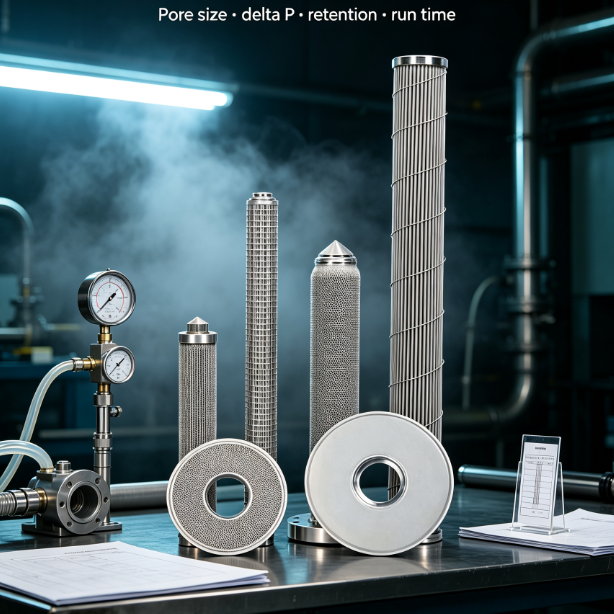


Filtering Recycled and PCR Feedstock: What Extrusion Plants Must Change in Their Filtration Setup
A Film Line Ran Virgin Specs on PCR and Clogged in Six Hours
A film production factory in Southeast Asia took on a customer contract requiring thirty percent post-consumer recycled content and ran the line with the filtration setup it had always used for virgin resin. The pressure rise curve that used to take five days now took six hours, the line stopped twice per shift, and the gel count pushed the film into rejection. The plant had assumed recycled feedstock is simply dirtier virgin resin and needed a finer filter. The real problem was different: the contaminant profile is not the same population at a higher level, it is a different population entirely, and the filter media and the changeout strategy had to change with it.
Why PCR Contamination Behaves Differently
Virgin resin carries a small and predictable population of gel and catalyst residue. Recycled feedstock adds paper fibre, adhesive, aluminium foil fragments, wood, rubber and cross-linked polymer, and each behaves differently in the melt. Cross-linked gel does not soften at processing temperature, so it passes through or blocks rather than dispersing like a normal gel. Paper and wood carbonise and create black specks that are visible in thin film. Characterise the incoming contaminant population before choosing media; a micron rating chosen for virgin resin almost never suits PCR.
Media Selection: Depth Matters More Than the Number
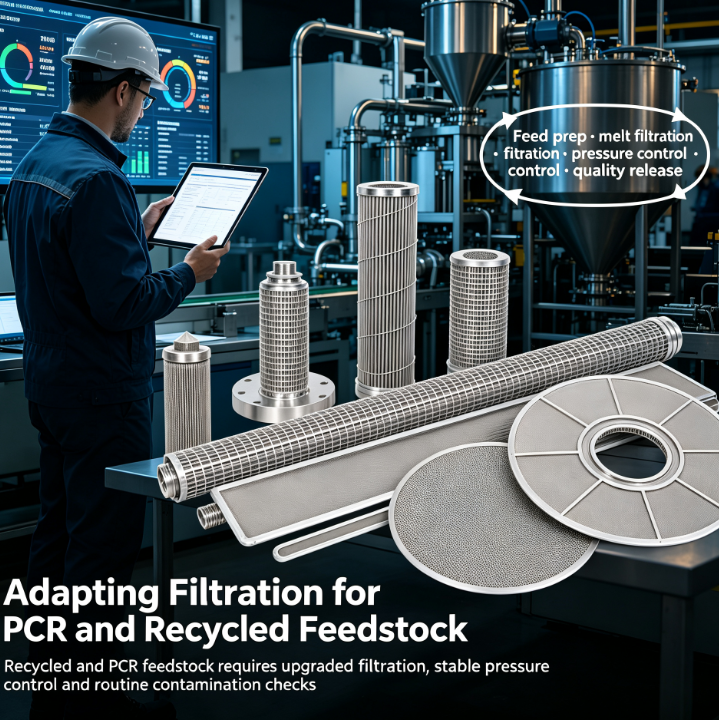
Plants typically respond by ordering a finer screen and create an immediate pressure problem. Increase filtration area and depth rather than only tightening the rating. A stainless steel polymer melt filter element with a sintered depth structure captures soft gel by absorption as well as by sieving, which is what keeps the pressure rise curve shallow with variable feedstock. A woven mesh at the same micron rating will blind far faster because contaminant sits on the surface. Ask the supplier for the dirt holding capacity figure, not only the retention rating.
Filtration Area Is the Real Buffer
The single most effective change for PCR is more filtration area per kilogram of throughput. Recalculate the required area using the measured contaminant load of the actual PCR stream, not the nominal resin grade. A polymer candle filter for film production gives a large area in a compact housing, and a pleated candle Filter Cartridge adds substantially more surface in the same envelope. Running PCR at the area that was adequate for virgin resin guarantees short cycles. Target a cycle length in days, not hours, and size the area to reach it.
Pre-Filtration and the Case for a Coarse Stage
With highly variable bales, add a coarse upstream stage to protect the fine element. A polymer extruder screen mesh filter in front of the main element removes the large hard fraction cheaply and extends the life of the expensive depth media by a large multiple. Skipping the coarse stage to save housing cost is a false economy, because the fine element then consumes its capacity on debris it was never meant to hold. Log the pressure drop across each stage separately so the plant can see which stage is loading and adjust the split.
Melt Temperature, Residence Time and Degradation
Recycled polymer has already been through one or more heat histories, and every additional pass reduces molecular weight. Lower the melt temperature where the process allows it and reduce residence time in the filter housing, because a large filter with poor flow distribution creates dead zones where polymer degrades and forms new gel. This is a common and confusing failure: the plant installs more filtration and the gel count rises. Check the flow path for stagnation before blaming the incoming material. Ask the filter supplier for the internal residence time at your throughput.
Changeout Practice With Dirty Feedstock
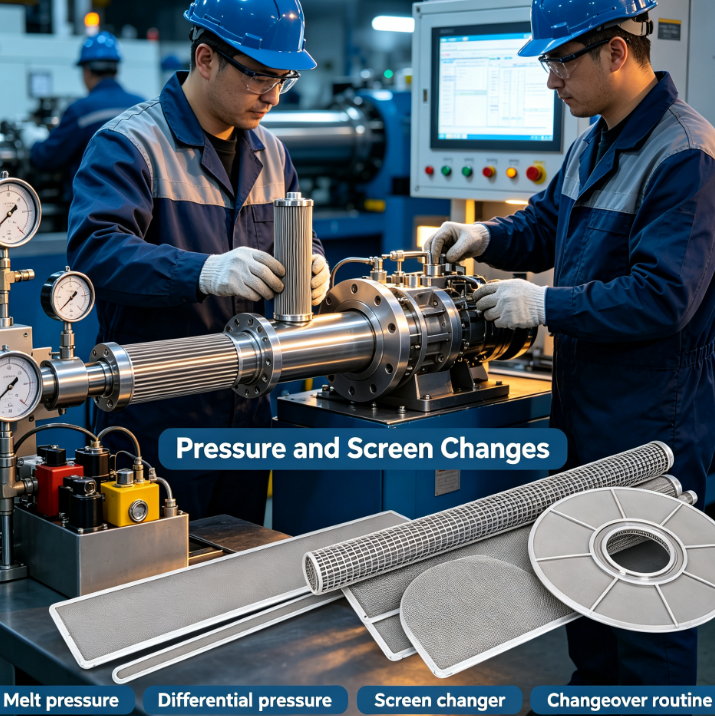
Cycle length becomes far less predictable with PCR, and the plant that changes on a fixed calendar either wastes element life or breaks downstream. Change on measured differential pressure with a defined alarm and a defined stop point. Keep a spare conditioned element ready so the changeover is quick. A continuous polymer filtration candle filter system is worth evaluating when the line runs high PCR content continuously, because it removes the stop-start pressure transient that causes gauge breaks and off-spec film.
Measuring Whether the Change Worked
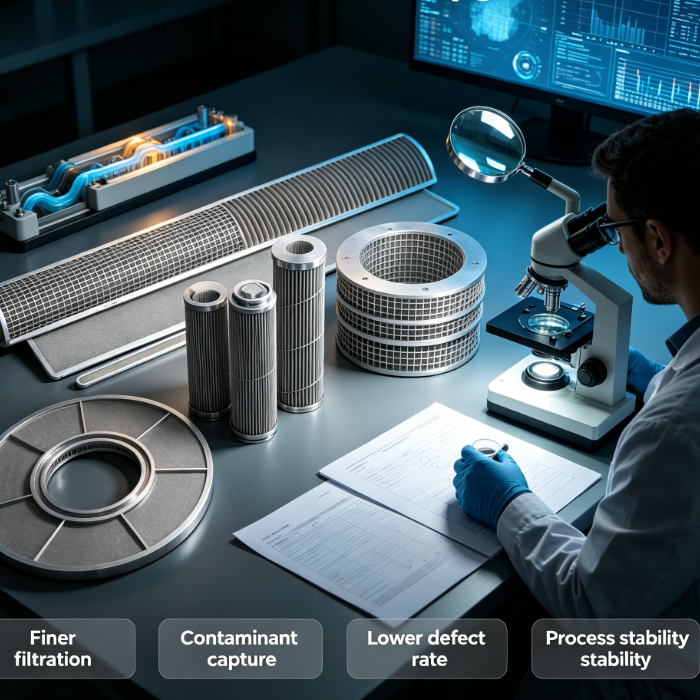
Do not judge the new setup on cycle length alone. Track four numbers: hours to reach the changeout pressure, gel count per square metre, black speck count, and scrap percentage. Compare them against the virgin baseline and against the customer's spec. A longer cycle achieved by coarser filtration that raises the gel count is not an improvement. Run the trial for at least three full element cycles, because bale-to-bale variation makes a single cycle meaningless. Where the trial shows the area is still short, a pleated candle filter cartridge is usually the fastest way to add surface inside the existing housing.
The Bottom Line
Treat PCR as a new contaminant population, not as dirty virgin, and add filtration area and depth before tightening the micron rating. Plants that simply order a finer screen buy shorter cycles and more stops, while plants that size the area, add a coarse stage and change on pressure hold both output and film quality.