

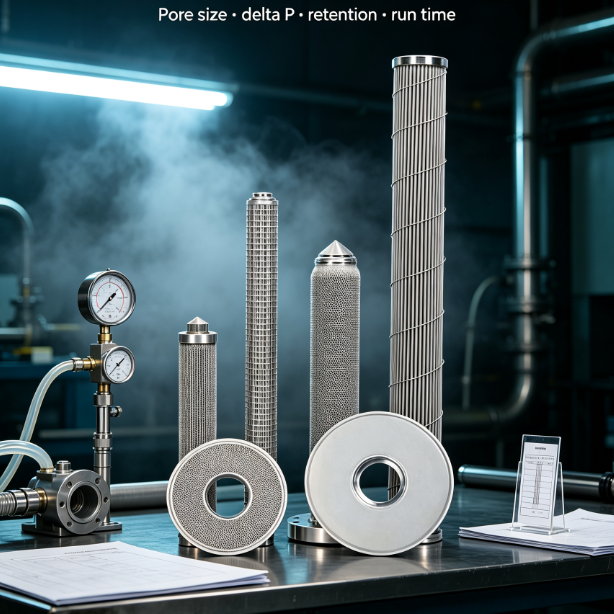


How Do You Choose Between Candle, Disc, and Screen Filters for Polymer Melt Filtration?
For extrusion and recycling plants, the Polymer Melt Filter is the component that decides whether a line runs clean or clogs by noon. Buyers rarely ask which filter is "best" — they ask which one matches their impurity load, pressure, and downtime budget. Foshan Beikaer Filter Equipment Manufacturing Co., Ltd. builds all three families, so the real job is matching the geometry to the process rather than picking a brand.
Start with impurity content, not with price
If your feedstock is relatively clean recycled flake with low gel content, a compact Candle Filter element is usually enough. The SUS 304 candle units hold 1–20 candles per housing and run filtration ratings from 1 to 200 microns, which is plenty for fine polishing of a stable melt. The polymer candle filter elements in SUS 304 are rated to 350°C and 10 bar differential, so they sit comfortably in most PET and PP lines without exotic alloys.
When the feed is dirty — high gel, catalyst residue, or heavy carbonized particles — the larger effective area of a leaf disc filter pays for itself. The polymer leaf disc filters for the plastic film industry are tuned for BOPA, BOPET, and BOPP lines where defect-free film is non-negotiable. Working pressure goes to 31.7 MPa and temperature to 300°C, with filtration grades from 5 to 100 microns, which is the band film producers actually live in.
Screen mesh for the recycling room
Plastic recycling and granulation lines have a different problem: variable, chunky contamination that needs a cheap, swap-able barrier. The polymer extruder screen mesh filters come in plain or Dutch weave, 25–300 micron, and shapes from round to kidney, so they drop into almost any screen-changer. For a recycler running mixed post-consumer flake, screen mesh is the lowest-cost first stage before a finer candle or disc polishes the melt.

The spec sheet that actually matters to your plant
Engineers tend to fixate on micron rating, but the numbers that bite you are differential pressure and dirt-holding capacity. A candle element with high dirt-holding capacity extends the replacement cycle and cuts unplanned downtime, which is where the real savings sit. The polymer melt filter elements in SUS 304 use stainless sintered fiber and wire mesh as the media, giving porosity you can regenerate by cleaning rather than throwing away — a point the procurement team should score heavily when comparing lifetime cost.
Material choice: 304, 316L, or Hastelloy
Most buyers default to SUS 304, and it covers the majority of polyolefin and polyester duties. Step up to 316L or Hastelloy only when you are filtering aggressive or high-temperature copolymers where chloride pitting would shorten a 304 element's life. Beikaer lists 304, 316L, 904L, and Hastelloy as available raw materials, so the upgrade path exists without changing suppliers.
QC questions to put to the supplier
Before releasing a PO, ask for the connector type list — Beikaer supports 222, 226, 215, M36, M28, M24, M22, and M20 threads, and the wrong connector means a filter that will not seat in your housing. Also confirm the filter length band you need; candle elements run 16–60 inches (406–1524 mm), and ordering the wrong length forces a housing retrofit. A five-minute drawing exchange with the factory prevents a two-week return loop.

After-sales and cleaning reality
The maintenance story is often the deciding factor for a plant manager. Disc elements can be ultrasound-cleaned and reused, which turns a consumable into a capital item you amortize over years. Candle elements regenerate similarly with CIP or backwash where the system allows it. Ask the factory for the cleaning procedure and the pressure-differential alarm setpoint before you buy, because a filter that clogs without warning is a line-stoppage waiting to happen.
- Candle: 1–20 elements per housing, 1–200 µm, up to 350°C
- Disc: to 31.7 MPa, 5–100 µm, reusable after cleaning
- Screen mesh: 25–300 µm, multi-shape, swap-in barrier
- Media: SUS 304, 316L, 904L, or Hastelloy
- Application: PET, PP, BOPP film, recycling, spinning
The buyer's checklist boils down to three questions: how dirty is the melt, how high is the pressure, and how long can the line stay down? Answer those and the candle-versus-disc-versus-screen decision makes itself. For film and high-purity spinning, lean disc; for steady recycled flake, a candle element; for dirty granulation, screen mesh first. Matching the right filter geometry to the duty is what keeps a filtration budget sane.
How to size the housing before you size the filter
A common mistake is specifying the element first and discovering the housing will not seat it. Confirm the housing dimensions and connector standard from your line builder before releasing the PO, because a 60-inch candle or a wide disc that does not fit means a housing retrofit, not a simple swap. Beikaer's listed connector options — 222, 226, 215, and the M-series threads — cover most standard housings, but the wrong choice strands the order. Match the filter to the vessel, then match the vessel to the pressure and temperature your process actually runs, and the element becomes a consumable you control instead of a bottleneck that controls you.
