


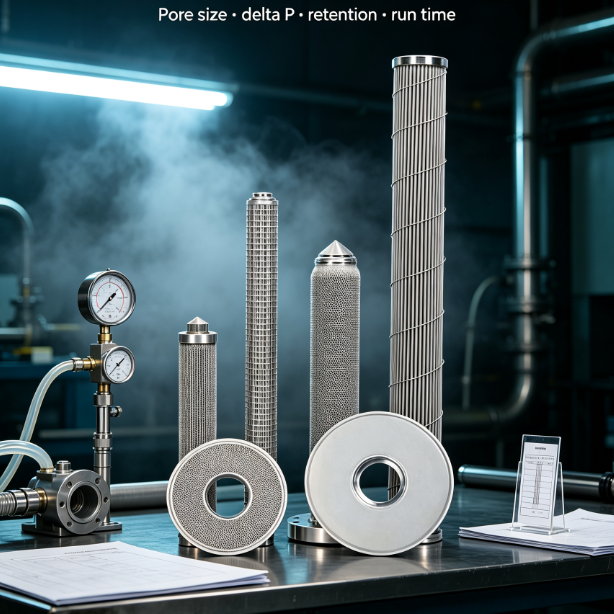


Micron Rating, Pressure Drop and Service Life: Specifying Polymer Melt Filters for Extrusion Lines
A film line in Gujarat changes Filter Elements every eleven days. The plant across town runs twenty-three. Same polymer, similar throughput, same nominal micron rating. The difference is not the filter brand. It is what happens inside the element between the inlet and the outlet, and almost nobody specifies it.
This guide is for plastics extrusion plants, film production factories and polymer machinery buyers who purchase filter elements as a recurring cost and suspect they are specifying them badly. They usually are.
Nominal Micron Rating Is Nearly Meaningless on Its Own
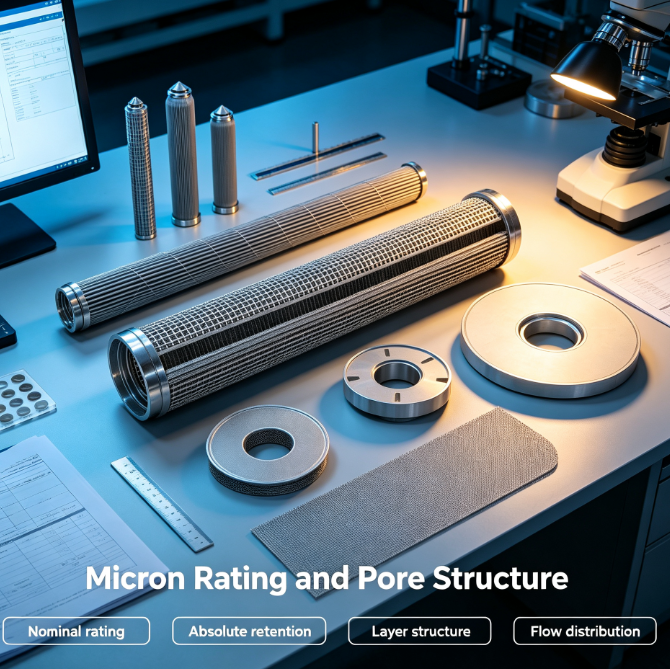
Nominal rating tells you the particle size at which a filter removes some stated percentage of contaminants, and the percentage varies by manufacturer. Absolute rating means something stricter. Without knowing which one you were quoted, and at what efficiency, the number on the datasheet cannot be compared between suppliers.
Always ask for three things together: the rating method, the efficiency percentage, and the beta ratio. A filter rated 25 micron nominal at 60% efficiency and one rated 25 micron absolute at 99% are completely different products, and the cheaper one will let gel particles through to your die.
What Gel Actually Costs You
A single gel particle reaching the die lip on a BOPP or cast film line produces a defect that shows up as a streak down the entire web. The scrap is not the filter element, it is the roll. Calculating the cost of one avoidable defect event usually reframes the whole filter purchasing conversation within about thirty seconds.
Pressure Drop: The Number That Runs Your Line
Every filter starts clean and ends blocked. What matters commercially is the shape of the curve in between.
- Initial pressure drop determines how much headroom your extruder has at start-up.
- Rate of rise determines how often you stop to change elements.
- Terminal pressure drop is the point at which the element must be replaced, and it is usually set by your screen changer or your melt pump limits rather than by the filter.
Dirt holding capacity is the specification that buys you service life. A sintered metal fibre medium with a graded pore structure holds substantially more contaminant per unit volume than a plain woven mesh of the same rating, because it captures particles through the depth of the medium rather than only on the surface.
When you compare options, ask for the pressure drop curve at your actual melt flow index and throughput, not at a generic test condition. A curve measured on a different polymer tells you nothing useful. Start with a known reference such as a SUS 304 polymer melt filter element and ask for the curve measured on your own polymer.
Element Geometry: Candle, Leaf Disc or Screen Pack
Candle Filters
Cylindrical elements arranged in a bundle. Large filtration area in a compact housing, well suited to continuous Polymer Filtration with backflushing. Cleaning and reuse is possible with the right construction, which changes the economics considerably for high-volume plants.
For film work specifically, a candle filter built for film production is usually the right starting point, because the filtration area per housing volume is what keeps the change interval long.
Leaf Disc Filters
Stacked discs on a central shaft, rotating through the melt stream. Strong choice for film production where consistent fine filtration matters and where floor space is limited. Disc spacing and screen mesh together determine the effective rating, which means two elements with the same nominal rating can behave very differently.
Screen Mesh Filters
The simplest and cheapest option, and still the right answer for many applications. Low capital cost, single use, and easy to change. The limitation is area: as throughput rises, change frequency rises with it. Standard extruder screen mesh filters remain the benchmark that any upgrade has to beat on cost per operating hour.
Selection shortcut: if you are changing screen packs more than twice a shift, the labour and the downtime usually justify moving to a candle or leaf disc system. Below that, screen packs remain the most economical answer.
Material and Construction Details Worth Specifying
Stainless grade matters more than most buyers expect. SUS 304 is adequate for many polymers, but processes running at higher temperatures, or with corrosive additives or recycled content containing PVC residues, justify 316L. Ask your supplier which grade they use for the weave, the support core and the end fittings, because they are not always the same.
Pleated constructions change the arithmetic again. A customised pleated candle filter cartridge packs more surface area into the same envelope, which lowers the initial pressure drop and lengthens the interval between changes.
The end fitting is where elements fail. A well-built Filter Medium welded to a poorly machined collar leaks, and the leak bypasses the filtration entirely while looking fine on the pressure gauge. Inspect the weld quality and the thread fit on the first batch.
Selecting Against Your Actual Process
Match the element to the job rather than to the previous purchase order:
- Virgin polymer, standard film: screen mesh or leaf disc, moderate rating, lowest capital cost.
- Recycled content: high dirt holding capacity matters far more than fine rating. Candle filters with depth media.
- High value optical or capacitor film: fine absolute rating, graded pore structure, and a documented clean-room assembly process.
- Fibre spinning: consistency of rating across the batch matters more than the rating itself.
Continuous processes with backflushing have their own economics again, and a continuous CPF candle filter system for polymer manufacturing should be evaluated on cost per year rather than cost per element.
What to Ask Before the Next Order
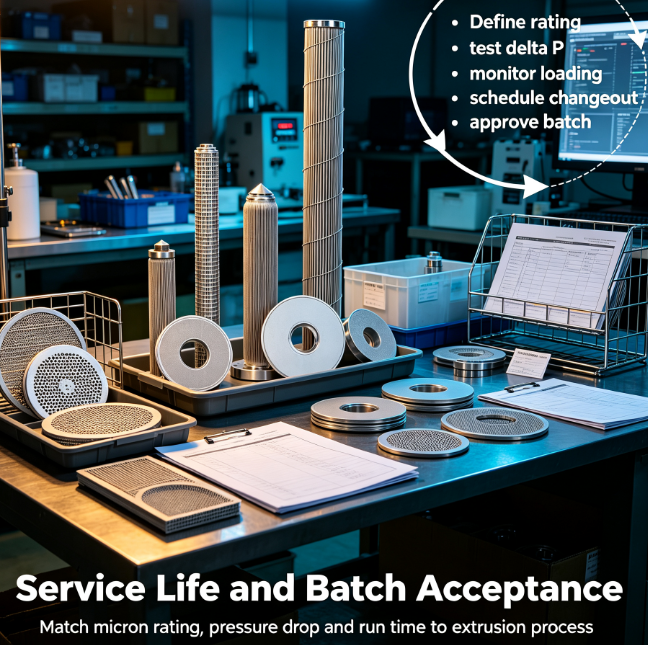
Request the pressure drop curve at your conditions, the beta ratio and rating method, the dirt holding capacity in grams per element, the stainless grade for each component, and whether the element can be backflushed or ultrasonically cleaned and reused. Then run one batch and record the actual service hours.
The Bottom Line
Stop buying micron ratings and start buying dirt holding capacity, pressure drop behaviour and documented material grades. Calculate what one gel-induced defect costs you, specify against your real process conditions, and record service hours on every batch.