


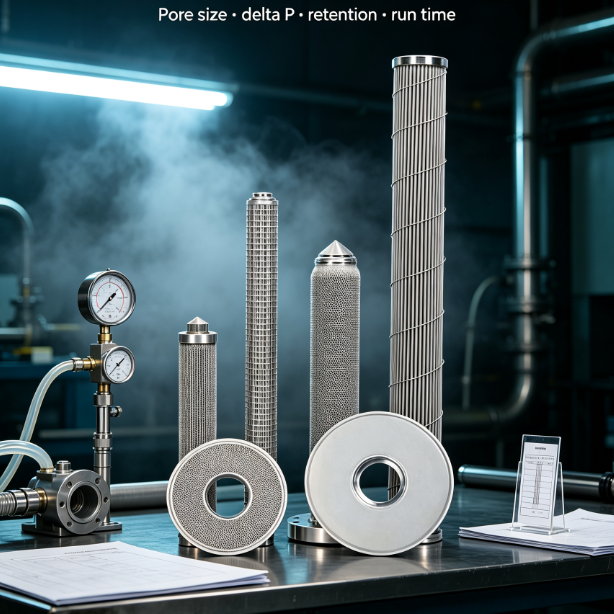


Media Construction Under the Micron Number: Sintered Mesh, Pleated Mesh and Depth Media Compared for Polymer Melt Filtration
Two Filters With the Same Micron Rating and Very Different Results
A film production plant replaced a polymer melt Filter Element with a cheaper alternative carrying an identical micron rating, and the swap passed the purchase comparison without comment. Within two production days the line was producing film with visible gel specks, and pressure rise across the filter housing was climbing far faster than on the previous element. The micron number was the same. Nothing about the construction was: the outgoing element used a sintered multi-layer mesh and the incoming one used a single-layer weave with a similar nominal rating. Micron rating is the most quoted number in this category and the least complete description of what the element actually does.
What a Micron Rating Does and Does Not Tell You
A micron rating on a woven mesh typically describes the largest spherical particle that can pass the aperture under a stated test, or in some cases a nominal value derived from the weave. It says nothing about how many layers the melt passes through, how the aperture holds its shape under pressure, how much dirt the element holds before it blinds, or how the media behaves when the polymer is highly viscous. Treat the micron number as one line in the specification and require construction details alongside it, because two elements with the same rating can differ by a factor of several times in service life.

Sintered Multi-Layer Mesh
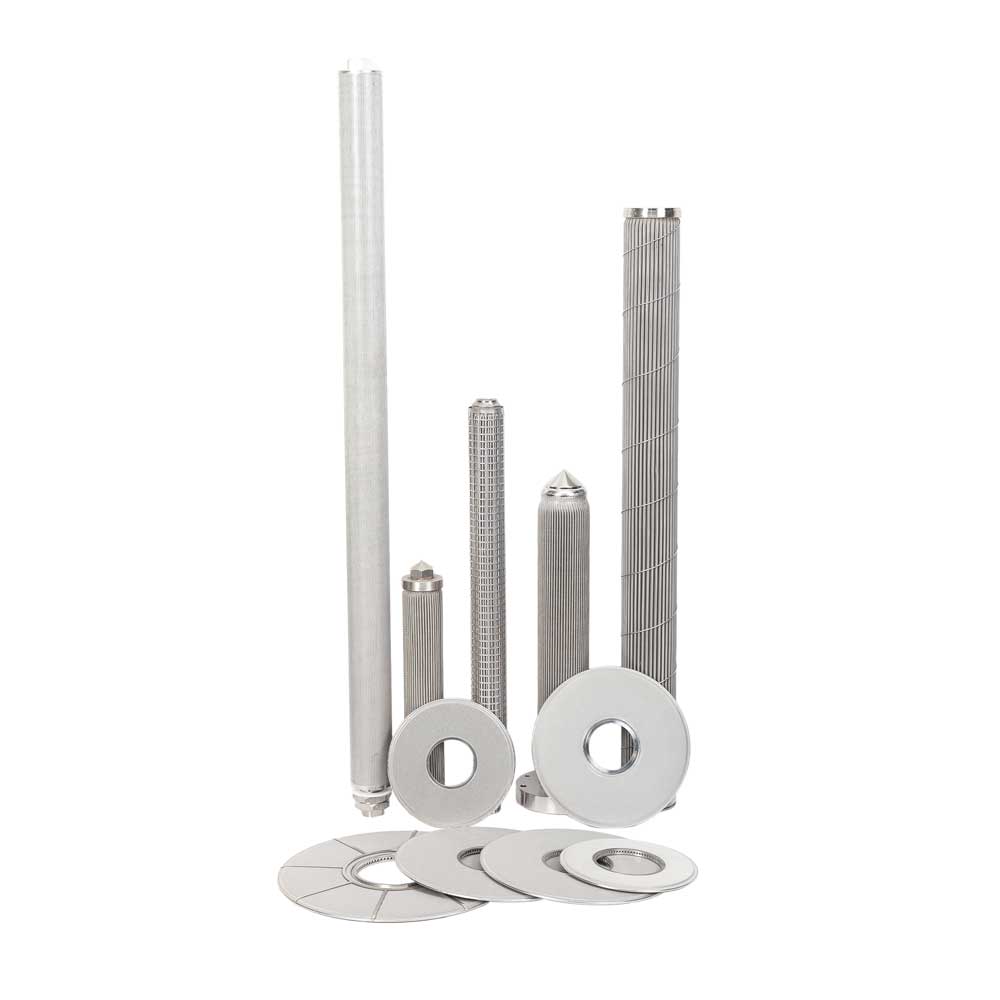
Sintered mesh is built by bonding several woven layers into a single diffusion-bonded sheet. The bonding locks the weave geometry so the aperture cannot deform under differential pressure, and the multiple layers give a tortuous path that catches particles below the nominal aperture size. Choose sintered construction where pressure stability, consistent cut point and long service life matter more than initial element cost.
The trade-off is cost and, in some configurations, a higher clean pressure drop. A sintered element that is too fine for the throughput will show an elevated start-up pressure that the line cannot absorb, and the operator will respond by raising temperature, which damages the polymer rather than solving the filtration problem. Size the element to the extruder throughput first, then select the finest cut point the available pressure window allows.
Pleated Mesh Constructions
Pleating increases the filtration area available inside a fixed envelope, and that is the whole point. More area means lower velocity through the media, slower pressure rise and longer runs between changes. A customised pleated candle filter cartridge is the standard answer when a plant needs longer service life without enlarging the housing, and it is often the most economical upgrade on an existing line.
Pleat design has its own failure modes. Pleats that are too tightly packed restrict flow at the root and create dead volume where polymer stagnates and degrades, and degraded polymer in a dead zone is a direct source of black specks. Ask for the effective filtration area, the pleat count and the pleat depth, and confirm the pleat spacing suits the viscosity of your polymer, because a pleat geometry optimised for a low viscosity grade will not drain properly on a high viscosity one.
Depth Media and Nonwoven Constructions
Depth media capture contaminant through the thickness of the material rather than at a surface. They hold a great deal of contaminant relative to their size, and they are effective on soft, deformable gels that a surface mesh can squeeze through. Use depth media where the contaminant load is high and where gel deformation is the failure mode.
The limitation is predictability. A depth medium does not have a sharp cut point, so the particle size it retains changes as it loads, and the pressure curve is less linear than a mesh. Where a process demands a defined retention limit, a mesh construction is the safer specification; where the requirement is dirt holding capacity, depth media win. Many lines run a depth layer upstream of a mesh layer for exactly this reason.
Wire Mesh Grades and Housing Compatibility
Material grade is a construction decision as much as a corrosion one. SUS 304 is adequate for many general extrusion duties, while SUS 316 is specified where the polymer, the additive package or the cleaning process introduces chlorides or aggressive residues. Selecting 304 for a line that later switches to a flame retardant or a halogenated additive package produces corrosion that looks like a filtration failure.
A SUS 304 and 316 wire mesh filter for plastic extrusion should be specified with the grade confirmed against the actual additive package, not against the base polymer. Write the grade into the reorder specification so that a cost reduction on a repeat order cannot silently change it.
Match the Construction to the Process
Construction choice varies by process. Film production is sensitive to gel and black specks, so it favours stable multi-layer mesh with a defined cut point. High viscosity polymer needs a construction that drains and does not hold stagnant melt, which pushes towards fewer, deeper flow channels rather than dense fine pleats. Spunbond and nonwoven lines run high continuous throughput and value dirt holding capacity and long runs above all else.
A leaf disc filter built for the plastic film industry answers the film requirement directly, because a disc pack gives a large effective area inside a compact housing without the dead volume that a dense pleat risks at high viscosity.
A candle filter cartridge applied in spunbond nonwoven production optimises the same principle in the opposite direction, and the two form factors exist because the processes value different outcomes. Specify from the process requirement and let the form factor follow, rather than choosing a form factor and hoping the media suits it.
Viscosity Changes the Whole Calculation
High viscosity melt behaves differently through any media. Higher viscosity raises the pressure required to drive flow, increases shear heating, and slows the drainage that keeps a pleat or a depth layer working. A media selected on a low viscosity grade will blind prematurely on a high viscosity one even at the same micron rating, and the plant will blame the element supplier for a specification error made in-house.
A polymer candle filter configured for high viscosity substances exists because the flow channel geometry, not the aperture, is the controlling variable in that duty. Declare the viscosity range of every grade you run when specifying, and require the supplier to confirm the media suits the worst case rather than the easiest one.
The Specification Sheet to Write
Before any reorder or any supplier change, write down: micron rating with the test method it was derived from, media construction type, number of layers or pleat geometry, effective filtration area, alloy grade, target start-up pressure drop at the actual throughput, and the viscosity range of every grade run on the line. Require the replacement element to match all seven lines, not the first one. The plant that bought on the micron number alone paid for it in scrap film, a housing opened early, and a line stopped twice in one week.